The Islamic University of Lebanon (IUL) demonstrates its commitment to addressing climate change through its Climate Action Plan, developed with input from local government and community groups. The plan outlines specific actions the university is taking to reduce its carbon footprint, promote sustainable practices, and engage the broader community in climate resilience efforts.
This plan includes initiatives such as upgrading campus infrastructure to higher energy efficiency standards, integrating renewable energy sources, and conducting educational campaigns about climate change mitigation and adaptation. By collaborating with local government bodies and organizations, IUL ensures that its efforts align with regional sustainability goals, contributing to a unified approach to tackling climate challenges.
Through this shared Climate Action Plan, IUL actively supports Lebanon’s broader environmental policies and empowers the local community with tools and knowledge to participate in climate-positive actions.
Climate change is now affecting every country on every continent. It is disrupting national economies and affecting lives, costing people, communities and countries dearly today and even more tomorrow.
People are experiencing the significant impacts of climate change, which include changing weather patterns, rising sea level, and more extreme weather events. The greenhouse gas emissions from human activities are driving climate change and continue to rise. They are now at their highest levels in history. Without action, the world’s average surface temperature is projected to rise over the 21st century and is likely to surpass 3 degrees Celsius this century—with some areas of the world expected to warm even more. The poorest and most vulnerable people are being affected the most.
Climate change is the global phenomenon of climate transformation characterized by the changes in the usual climate of the planet (regarding temperature, precipitation, and wind) that are especially caused by human activities. As a result of unbalancing the weather of Earth, the sustainability of the planet’s ecosystems is under threat, as well as the future of humankind and the stability of the global economy.
Over the past two decades, Lebanon has actively worked on improving its capacity to adapt to and mitigate climate change. The country has actively participated in the UNFCCC (United Nations Framework Convention on Climate Change). Lebanon’s overall GHG (greenhouse gases) emissions are minimal compared to other countries due to the country’s size and relatively small industrial sector.
The university, through the strategy it adopted, has been working to reduce the effects of climate change through the adoption of several policies, including relying on green spaces outside and inside the university campus to reduce the percentage of carbon, interest in afforestation of the surrounding lands and motivate students to care about the environment by engaging them in multiple activities aimed to protect the environment and educate them environmentally through holding several seminars and workshops aimed at introducing them to the effects of climate change and the available means to reduce its negative effects on the environment and people.
13.3 Environmental Education Including Disaster Planning
The University strategy states the following “The promotion of sustainable and balanced development across Lebanese territory and the evolution toward global” and which is from the major social challenges that are tackled in the strategic plan of IUL. Also, it is mentioned in the letter of the President of the University which states that: “IUL has issued new specializations that are harmonized with the global change.
13.3.2 Does your university as a body have a university Climate Action plan, shared with local government and/or local community groups
Climate Action plan
Since the beginning of its foundation, the university had a commitment to a climate action plan in order to adapt to the effects of climate change. Therefore, it took this into consideration as we can see in its design and took into account the adoption of green spaces to alleviate the heat of the sun and increase the proportion of oxygen in the air, so that the percentage of green spaces reached more than 75% of the total area of land allocated to the campus, i.e. about 103,000 cubic meters and includes more than 2,200 trees. The adoption of green spaces was not limited to the exterior spaces only, but also it was designed in a way that overlaps with the buildings intended for students.
Concerning the irrigation of these areas, the university relied completely on rainwater harvesting through the construction of tanks to collect rainwater to re-pump it and use it for irrigation and at last filtering the remaining to meet the water needs of buildings.
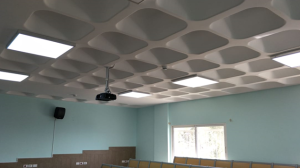
The engineering designs for the shape of the buildings took into account having natural ventilation. As for outdoor lighting at night, the university has relied on a renewable energy system through solar panels as an alternative to fossil fuels to reduce the carbon level.

Total Campus Area:
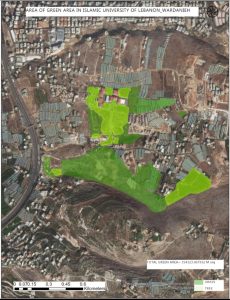
The following figure (in yellow) shows the total campus area of Wardanieh campus that is about 158.413.9-meter square.
Total area on campus covered in forest and Ratio of Total area on campus covered in forest to total area:
(In our calculations, we assume the tree’s coverage radius = 7.5 m).
The following figure shows the total area on campus covered in forest which is about 76.526.5-meter square.
The ratio of total area on campus covered in forest to total area = 76526.5/158413.9= 48.3%.
Total area on campus covered in planted vegetation:
The figure shows the Total area on campus covered in planted vegetation. This area is about 103.578-meter square.
The ratio of total area on campus covered in planted vegetation to total area = 103578/158413.9= 65.3%.
Efficient Energy Appliances and Energy Saving Campaign
As the campus is newly built and is equipped in 2016, the University has put a policy to use energy efficient electric appliances (rated 5 certified for energy savings), including luminaries where LEDs are used in the whole campus (100%). This will use at least 75% less energy, and last 25 times longer, than incandescent lighting according to US Energy Saver.
Smart Building
The Wardanieh campus is considered a smart building facility by using various technologies.
Safety
S2 – Fire-fighting system: it is available in all indoor buildings, through extinguishers, sprinklers, fire hose reel.
S2 – Fire Suppression system: critical zones such as Datacenters and telecom rooms are equipped with fire suppression system (FM200) in case of any fire incident.
S2 – Fire Alarm System: all indoor locations (rooms, corridors, auditoriums, …) are equipped with addressable Smoke/Heat detectors connected via fire rated cables to a central panel in each building (block), then all panels are connected together. Therefore, any fault will trigger a voice and an alarm to catch the attention of the responsible agent to interact. The system is also connected to both GSM and IP network to send emergency messages to the responsible.
S3 – Video Surveillance: the campus is equipped with up to 390 HD CCTV cameras that provide almost 100% coverage of all areas where public move, including administrative areas, classrooms halls, auditoriums, student facilities, open spaces, gardens, parking, roads, …
The monitoring is accomplished through an intelligent system that saves recording from all cameras up to 30 days, and provides a big wall screen (210cm x 371cm) to make real time supervision located in the “Campus Control Room”
Energy
E1 – Monitoring: the university uses an automatic acquisition and logging system of energy consumption for different sources of energy.
E2 – Management: the university uses a high availability automatic management system to manage the electricity usage from the different energy sources.
Water
A1 – Water management system: to monitor the level of water in the different tanks throughout the campus via the campus control room.
A2 – Water Recovery: the university has built a rainwater recovery system for covering the flushing and irrigation for the whole campus. The rainwater fallen on the building roofs and on the roads is collected in 11 tanks having a total volume up to 4987 cubic meters. The collected water is used on the campus for irrigation and services purposes.
Indoor environment
I4 – Passive System: Lebanon has a Mediterranean climate characterized by a long, semi-hot, and dry summer, and a cold, rainy and snowy winter. Fall is a transitional season with a lowering of temperature and little rain; spring occurs when the winter rains cause the vegetation to revive. A South west wind provides relief during the afternoon and evening; at night the wind direction is reversed, blowing from the land out to sea.
Air movement is the most important element of passive cooling. It cools people by increasing evaporation and requires both breeze capture and fans for back-up in still conditions. It also cools buildings by carrying heat out of the building as warmed air and replacing it with cooler external air.
The well-designed openings (large windows, doors and vents) and unrestricted breeze paths inside the buildings provide a passive cooling for all indoor locations.
Lighting
L1 – LEDs: As the campus is newly built, all indoor and outdoor luminaries are LEDs, even the road lighting

L2 – Sensors: All streets LED lights are equipped with LDR sensors to illuminate automatically at night.
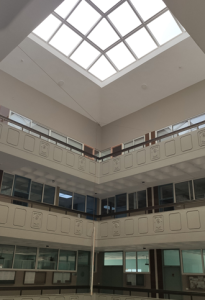
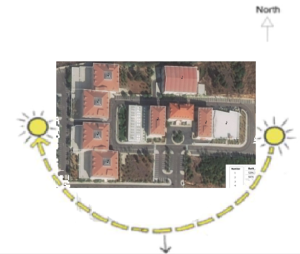
L4 – Natural Light: The locations of the buildings were directed in relation to the north and south points. It is the appropriate direction according to the location of Lebanon. Where the sun rises from the east and sets to the west, passing through the south. This will provide natural lighting starting at 7 am and throughout the year. The square shape of the educational buildings with a courtyard in the middle, and wide glass windows in the east and the west walls, provides ideal natural daytime lighting for the entire building.


Renewable energy produced on campus per year
The amount of renewable energy produced by the campus renewable sources is calculated as follow:
Electricity usage per year
The electricity supplying the campus comes from three sources, the first is provided by EDL (Electricité Du Liban), the Lebanese public electricity provider, the second source is the university generators and the third from the renewable energy sources:
The total electricity usage per year in the campus: (h.1) + (h.2) = 738,776 KWh
Ratio of renewable energy produce/production towards total energy usage per year
The ratio of renewable energy produced towards total energy usage per year
= 21,600 KWh/ 738,776 KWh = 2.923%
Elements of green building implementation as reflected in all construction and renovation policy
The green building elements implemented in the campus as reflected in construction policies comprises four axes: site design, indoor air quality, energy savings, and water.
Site design:
The design of each building facilitates the ventilation and the natural light
IUL works on increasing green area inside and outside of the buildings
Indoor Air Quality:
Energy savings:
Water:
Waste (WS)
Program to reduce the use of paper and plastic in campus:
Program 1: All the papers and cartons in the university stores, and after a certain period, are sold to a factory to be recycled.
Program 2: Plastic bottles are collected for later recycling. The objective is to help deaf persons from the collected amount of this program.
The Sewerage on the university campus is treated conventionally and is connected to the sewage network of Wardanieh municipality.
Water (WR)
Water conservation program implementation
The rainwater fallen down on the campus internal roads and parking areas and on the buildings floors are gathered in 11 underground tanks.
This amount of rainwater is collected from the inside roads, parking and from the roofs of the buildings. Each area is highlighted by a color related to the tank that collects rainwater of this area.
The collected water is used as follows: 80% for irrigation and 20% for service.
Several means are used to reduce water loss in Wardanieh campus:
To reduce water loss in irrigation, drip irrigation and stream-rotator sprinkler technologies are used for about 90% of the plantations and trees throughout the campus.
Transportation (TR)
Number of cars actively used and managed by the University
There are 3 cars used and managed by the university in Wardanieh campus, these cars are used for the shuttle service of the students.
Number of cars entering the university daily
All vehicles entering the Wardanieh campus should have tags with university logo. These tags are available for students, professors (fulltime and part time) and administrative staff who want to access the university with their cars. The number of cars having university tags is up to 235 cars. The percentage of cars with tags entering daily the campus is around 80% from the total cars.
Therefore, the average total number of cars entering daily the university is about 188 cars (235*0.8).
Number of motorcycles entering the university daily
The average number of motorcycles entering the university daily is about 15 motorcycles.
Shuttle services
The shuttle service from Khaldeh campus, Saida old city and from Saida-Beyrouth highway to Wardanieh campus, is available regularly and without any charge for all students, professors and employees.
Number of shuttles operated in IUL University
There are two types of shuttles to transport students, professors and employees:
Therefore, the total numbers of shuttle buses are 7.
Average number of passengers of each shuttle
The capacity of each shuttle bus is about 20 passengers.
Total trips of shuttle services each day
For each working day, there are:
One daily trip from Wardanieh campus to Saida old city.
Awareness campaigns of the sustainable development objectives (desertification, pollution..):
1. Webinar on Climate Action in Construction and Building Industry.
SAVE THE DATE-16 SEPTEMBER 2021 – Webinar on Climate Action in Construction and Building Industry,
As part of the efforts to enhance climate action among arab youth, the Islamic University of Lebanon, Yarmouk University, and Tanta University in collaboration with the American Concrete Institute (ACI) and the United Nations Economic and Social Commission for Western Asia (UN ESCWA), are organizing a Webinar on Climate Action in Construction and Building Industry. The Webinar will convene experts on climate change, green urban planning, and Construction material with university students from Arab countries.
In the webinar the speakers will go over:
➢ Improve understanding on the importance of addressing climate change in the Construction and Building Industry and the role of Arab youth in enhancing climate action in the region.
➢ Promote a science-policy interface through showcasing a comprehensive scientific assessment of the impacts of climate change on key sectors in the Arab region, based on findings from RICCAR, and how it supports climate-informed policymaking.
➢ Highlight the role of climate-responsive, green economy policy frameworks at the national and city levels, with examples from Jordan.
➢ Raising awareness about the impacts of construction materials on climate change and discussing ways to mitigate the environmental footprint of construction materials using innovative methods and technologies.
Logistics:
The webinar will be held via Zoom on Thursday, September 16th 2021 at 17:00 Beirut time
Register Today!
CLICK THE LINK TO REGISTER!
https://zoom.us/…/tJArcuyvqD8jHddEU96dPyjSRUyZXBrnwddu
Looking forward for your participation.
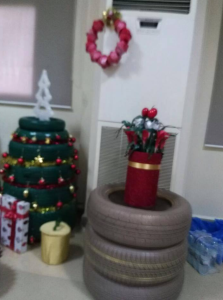
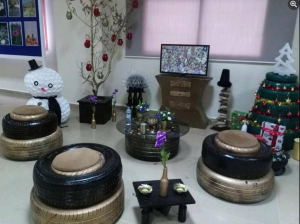
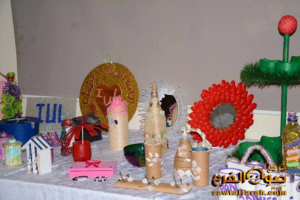
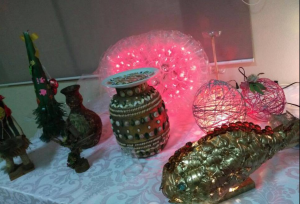
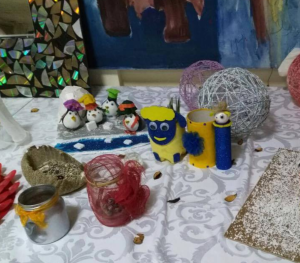
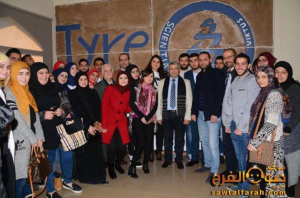
Under the title of Our Will, We Make the Green Tomorrow, second-year students at the Faculty of Economics and Business Administration organized a handmade art exhibition, as all the contents of the exhibition were prepared for perishability, as they were recycled and used in a beneficial manner.
Venue: The Islamic University of Lebanon – Tyre
When: 12/21/2016

3.Environment and Sustainable Development – Challenges and Solutions.
4.Bekaa water crisis “problems and solutions” at the Islamic university table in Baalbek
The Islamic University of Lebanon- Baalbek Branch organized a seminar on the “Water Crisis in the Bekaa”, in cooperation with the Bekaa Water Foundation and the Italian Civil Volunteering Association, in the presence of the patron of the Diocese of Baalbek for the Roman Catholic Royals Bishop Elias Rahal, Mufti Sheikh Abdou Qataya, President of the Baalbek Municipal Union Nasri Osman, Chairman of the Board of Directors and Director General of the Bekaa Water Foundation Engineer Rizk Rizk, member of the presidency of the Movement of Amal Brig. Gen. Abbas Nasrallah, head of the Center for Civil Organization in Baalbek Engineer Jihad Haidar, Joanna von Gutenberg, Director of Water Projects in Lebanon at GVC, Mayor of Baalbek, Brigadier General Hussein al-Laqis, represented by Captain Mohamed Taha, head of the movement’s municipal affairs office in the Bekaa, Abbas Morteza, deputy official of Hezbollah’s municipal work in the Bekaa, Hani Fakhreddin, and academic, educational and social activities.
Dr. Zain al-Abidin Haidar, addressing the Islamic University of Lebanon, said: “When it comes to the issue of water and its preservation, who is more keen than the state of Speaker Nabih Berri, aware of its life and economic importance, he spares no effort to support all relevant studies and work, from his daily insistence on resolving the issue of Litani, to the establishment of the Assi Dam, not ending with the support of our meeting.”
“FAO’s climate and hydrological studies, leading up to the Dublin Conference on Water and Sustainable Development in 1992 and the Rio de Janeiro Summit in the same year, have all come to several conclusions, including that freshwater sources are very limited and weak, necessary for the preservation of life and the environment, that water management must be based on a participatory rather than exclusive approach, and that household consumption and community education play an important role in water conservation and consumption, and most importantly, “Water has great economic value in all its uses and must be recognized as an economic commodity, and these conferences have stressed the importance of collecting the right information and accurate climate data, so that decision makers can rely on clear indicators to know treatment methods such as dam construction, well drilling, network development, etc.”
“The National Center for The Quality of Medicine, Food, Water and Chemicals at the Lebanese University published the results of the analysis of water samples in a number of bekaa areas, which showed that bacterial contamination affects surface and groundwater and distribution networks, so lip water in the Bekaa is almost undrinkable. “If this indicates anything, it shows that the health of the citizen is in great danger, so what do we leave to our children and to future generations of water, least of which is to drink.”
“Many unfavourable conditions have led to a decrease in the amount of water available in the Bekaa, including climate change, decreased rainfall, Syrian displacement, life development that has led to an upward increase in water consumption, contamination of surface and groundwater sources, and the drilling of random wells that have drained groundwater,” Rizk said.
“No one thinks that the Bekaa Water Corporation, which began operation in 2002, is solely responsible for water, but every citizen is responsible for water conservation and quality,” he said.
“The foundation is suffering from a shortage of human resources, with 190 employees, in addition to 180 out of demand, and a shortage of about 500 people according to regulations that have not noticed any sanitation user, and under the suspension of employment,” he said. “We are facing a major challenge, and without the support of the Ministry of Energy and donors, the foundation would not have collapsed, and we would not have been able to provide water in the Bekaa.”
He announced that the company’s debt amounts to 161 billion lire, of which 89 billion lire for the Lebanese Electricity Corporation, 5 billion for Zahle electricity, 11 billion for municipalities and 11 billion for guarantees.”
“We have lip water and sanitation plans, and studies and plans for irrigation water are being prepared, with the support of the Ministry of Energy and Water and donors.”
“We are a humanitarian non-profit organization, we have been working since 2006 in Lebanon, and today we are celebrating World Water Day with you, to send a message that everyone has the right to water,” von Gothenburg said.
“The most important obstacles and problems in Lebanon are that not everyone in Lebanon has proper access to water,” she said, adding that “we are working on water projects in Lebanon in two areas, to provide additional water sources to meet the needs of displaced Syrians, and to ensure the needs of host communities, which in turn suffer from water shortages.”
Dr. Talal Darwish pointed to a shortage of water resources in the Bekaa, and said: “Statistics confirm that the overall path of the amount of water available is a downward path, knowing that the largest agricultural holdings and the largest use of groundwater we find in Baalbek Hermel, Lebanon among the Arab countries threatened by water shortages and scarcity, and what is needed is to improve water management so that we can make greater use of our water.”
Arab Youth Hackathon “Solutions for Change”
If you have innovative solutions to combat the effects of climate change in areas of: agriculture, circular economy, water security, renewable energy and optimal utilization of resources.
Join the Arab Youth Hackathon “Solutions for Change”
You need to form a team from 3 – 2 people of diverse skill levels with one member over 21 years of age”
3 will qualify competitors from each country to participate in the final hackathon that will be held in Dubai. The top three places will receive support of the Plug and Blug incubator, a month-long training to transform the idea into a startup, as well as a financial prize from the Pepsico Foundation:
Deadline for applications: October 8, 2023
Make an application now…
https://arabyouthhackathon.com
@ PepsiCo ;@Berytech ; @Plug and Play Tech Center; @ Arab Youth Center مركز الشباب العربي
For more information contact:
Unleash Your Creativity at Idea Lab 2.0!
Calling all forward-thinkers and eco-innovators! Step into the spotlight with this program focused on agrifoodtech and cleantech. 🍏 Ignite your potential through hands-on training, interactive workshops, and personalized mentoring, all designed to empower you in shaping a greener future.
Don’t miss out on the opportunity to make a difference and bring positive change.
Visit park-innovation.com/idea-lab/ to discover the criteria and apply today. Selected candidates that fulfill the requirements will be contacted for the next steps, including the date and timeline of the program. Spread the word and tag someone you know with an innovative idea!
Apply now at 👉 tiny.cc/idealab2
This initiative is a collaboration with Berytech (@berytech_) and is proudly supported by The Embassy of The Netherlands in Lebanon (@nlinlebanon).
Annual orientation exhibition in the Agricultural Village Center
With a special presence, the Islamic University of Lebanon Baalbek branch participated in the annual orientation exhibition organized by the Lebanese Society for Studies and Training in the Agricultural Village Center in Baalbek in the presence of a large number of Lebanese universities.
High school students in official schools from Baalbek city, Arsal Al-Ain, Dir Al-Ahmar and northern Bekaa villages participated in the exhibition.
As the Islamic University in Lebanon provided a detailed explanation to students about the branches of the university extended over the country, especially its new branches in the Western Bekaa areas and Burj Al-Barajna Tower, and about the available specialties and the grant system.
In its turn, the Organizing Society praised the exhibition for the special role of the Islamic University and the message it presents.
With Our Will We Create a Green Tomorrow
Under the title: With Our Will We Create a Green Tomorrow, second-year students at the College of Economics and Business Administration organized a handmade art exhibition, as all the contents of the exhibition were intended for destruction and were recycled and exploited in a useful way.
Location: The Islamic University of Lebanon – Pictures


“Problems and solutions” on the table of the Islamic University in Baalbek
Within the framework of the challenge to the impacts of climate change, the university has been cooperating with the local community, especially with the municipalities, on activities that contribute to adaptation and reducing the risks of climate change, so it organized several campaigns, including the Cleaning Campaign along the southern shore in cooperation with the Union of Municipalities of Tire.